What Must Never Be Spent
By Dr. Pooyan Ghamari · · 8 min read
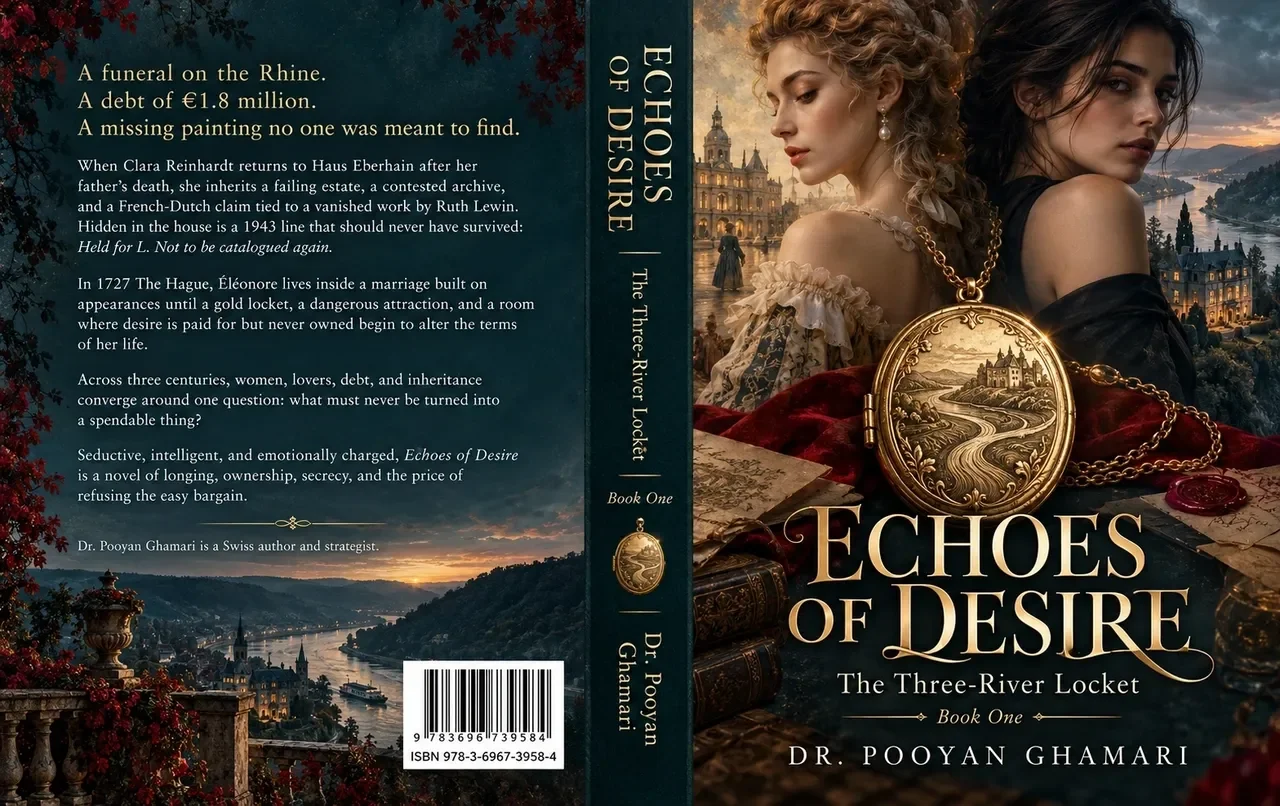
Why I wrote Echoes of Desire: The Three-River Locket
By Dr. Pooyan Ghamari
For years I have asked the same question in different rooms. Who gains? Who pays? Who decides? Who is kept out of the decision? It is a useful question for states, currencies, sanctions, companies, property, and empires. It becomes harder, not easier, when it is moved out of those rooms and set down inside a marriage, a bedroom, an inheritance, a family archive, or a body.
That is why this novel exists.
I did not want another argument about power. I wanted power in a room with someone it desired. I wanted to see what money becomes when the thing being priced is a house, a memory, a night, a painting, a name, a woman’s freedom, or the future of a family. And I wanted a question that markets dislike. Are there things whose value begins where their price ends?
Fiction was the only form that would not let me win too early. An essay is obedient. The writer chooses the evidence, times the objection, and arrives where he meant to arrive. A novel refuses that comfort if the people in it are alive. They start resisting the philosophy that hired them.
Victor had to be right about the roof. Clara had to pay for being right about the archive. Éléonore had to learn that freedom does not cancel jealousy. A good rule had to fail someone. Love had to become dangerous without becoming a crime. Money had to stay necessary after it had stopped being a moral answer. Desire had to remain desire, not philosophy with the lamps turned down.
The book opens on an object, a gold locket, and moves between The Hague in 1727 and a house on the Rhine in 2026. Éléonore is married and learning how hard it is to tell desire from possession. Clara inherits a failing estate, a large debt, a contested archive, and a trace that a painting by the Jewish artist Ruth Lewin passed through the family in the Nazi years. Three centuries sit between them. The problem does not.
We talk about freedom as if it were a legal condition. Nobody has chained you. The contract has your signature. You said yes. A person can enter a room freely and find that leaving it is expensive. A person can consent and still see that the other roads were cruel. A person can love someone and refuse the future that person wants. A person can hold legal title and have no moral right to keep the thing.
Sex matters in the novel for that reason. It is not decoration and it is not a separate subject from economics. In the space between two people, ownership, bargaining, consent, jealousy, and debt become physical. A hand moves. Another hand stops it. Someone waits. Someone wants to be preferred. Someone wants the night and refuses the household that might follow it. The body finds, quickly, what political language can spend a hundred pages avoiding. Power is not only the ability to force another person. It is also the ability to make refusal expensive.
Sara is the hardest case. She is not kidnapped. She is an adult. She decides. Something is still wrong. Her circumstances narrow the road until the word choice becomes too clean. I wanted both sentences to survive: it was yes, and it was not free. Public argument usually demands one. Either she chose, so nothing else counts, or the pressure was real, so the choice must be erased. I distrust both. A person can have agency and still be used. Economic pressure can matter without turning an adult into an object. A bad choice can remain a choice. Respecting her dignity meant refusing to rewrite her as wholly sovereign or wholly helpless.
The roof gave me the other collision. Victor wants to save Haus Eberhain with a hotel. It would have been easy to make him the commercial villain, the man who turns history into suites. Then there is the roof. It leaks. There is debt, payroll, a moving wall, a bank. Water does not care which painting is stolen and which invoice is innocent. Clara cannot say that history matters and expect the felt to repair itself. Victor cannot say that the numbers work and expect provenance to vanish. The dangerous decisions are often made when two legitimate facts meet and someone has the power to declare one of them irrelevant. The house is a small political economy. Assets, creditors, labour, inheritance, title, moral claims, and not enough time. What looks like a family quarrel is the national question in a corridor. What will we sell in order to survive, and what happens if survival requires the thing that made survival mean anything?
The Lewin painting refuses a clean chain of title. An invoice exists. A transfer is recorded. A buyer paid. Decades pass. The object becomes part of another family’s story. Then a ledger shows the sentence under the transaction. Records can preserve truth and manufacture legitimacy with the same ink. A theft can learn the language of a sale. Possession, given enough years, starts to narrate itself: we have had it, it belongs here, it is our history. The novel does not answer whether time turns possession into legitimacy. That refusal is the point.
Writing the erotic scenes was the part I could not hide behind. Systems allow distance. A novel about desire does not. I cannot ask whether a state may control another people’s choices and then become timid when the same question appears between two adults. I wanted bodies to matter without people being reduced to bodies. Pleasure that does not pretend to solve power. Consent that does not sound like a form. Jealousy after permission. Love tested, because love is often treated as the moral exception to ownership. It should not be. A person can say I love you and mean therefore you are mine. The book asks whether another sentence is possible. I love you, and I will not require possession in order to prove it.
Sovereignty, for me, begins smaller than a country. It is not unlimited power. A state cannot do everything it wants. Neither can a person. Both live inside consequence. Sovereignty here means the ability to decide what may be negotiated and what may not. Éléonore can take a lover and refuse him a household. Clara can admit the debt and still refuse to let the debt decide the painting. Sara can insist that the record keep both her choice and the conditions around it. Gabriel can want Clara and not use the claim to reach her. A woman can hold a key on her own side of a door. Before constitutions and central banks, there is a simpler question. Who controls the door?
The Latin on the locket, voluntas sola ligat, appears in English only twice. Clara finds it. The book ends on it. Will alone binds. I kept it rare because a sentence repeated becomes a slogan, and I wanted a problem. The phrase does not mean circumstance vanishes, or poverty cannot coerce, or law is irrelevant, or every choice is just. The novel contradicts those readings. It asks what remains yours when the surrounding world is trying to turn your life into a transaction. Property can be taken. Money can fail. A house can be mortgaged. A name can be ruined. History can be rewritten. Inside that pressure there has to be a point from which a person can still say: this far, not further. This I will negotiate. This I will not sell.
Near the end Clara refuses to translate the inscription for Victor. He could find the English elsewhere. That is not the point. All through the book, things are being priced. The house, the roof, the claim, the wage, the night, even history in a hotel presentation. She keeps one sentence outside that machinery. Not because it has no value. Because that value would shrink if it became useful. Markets are extraordinary. Not everything should enter one. Law is essential. Not every human truth becomes truer because a court can enforce it. Wanting is not ownership. A civilisation becomes dangerous when it can no longer tell value from price. A person does too.
I delayed publication because an unfinished manuscript cannot fail in public. It cannot be misread, attacked, or show more of its author than he intended. There is always the sentence, I am still working on it. The book made that excuse impossible. It is about people deciding whether to hold a thing, spend it, hide it, or let it leave the room. The manuscript eventually asked me the same thing. Publishing it is part of the experiment. I do not need every reader to agree. A novel that produces only agreement has protected itself too carefully. I would rather a reader argue with Éléonore, defend Victor, be angry with Clara, want Gabriel to cross the room, disagree with Sara, and read the locket differently. Fiction can keep several truths alive in one room without forcing one of them to win before the reader leaves.
The book contains sex, and it is not finally about sex. It contains money, and it is not finally about money. Under the painting, the house, the claim, the marriages, and the debts, one question remains. What part of a life must stay impossible to purchase? Every generation answers differently. Every relationship does. Freedom may not be the ability to possess everything we desire. It may be the ability to know what we desire without becoming its servant. Dignity begins when we can tell what has a price from what should never be priced. The inheritance that matters may not be the object. It may be the authority to decide.
That is why I wrote Echoes of Desire. Some things acquire their meaning by being kept. Others acquire it only when we finally let them go.
Original article: https://ghamari.org/articles/f/what-must-never-be-spent